


Share This Article
The Delhi–Amritsar–Katra Expressway has broken the clock: what was once a 90-minute drive from Kathua to Jammu now drags on for over four hours
ANUJA KHUSHU
Launched with great fanfare under the Bharatmala Pariyojna in 2020, the Delhi–Amritsar–Katra (DAK) Expressway was meant to cut travel time from Delhi to Katra by half. For Jammu & Kashmir, it promised economic uplift, seamless connectivity, and enhanced pilgrimage and strategic mobility. Five years later, in the Kathua–Samba–Jammu stretch, it has delivered little but dust, delays, and daily gridlock.
This once manageable 90-minute drive now routinely stretches into three to four-hour slogs through dangerous diversions, open trenches, incomplete bridges, and barren work zones. What should have been a flagship of infrastructure now looks like a monument to mismanagement.
Construction Delays: What’s Really Happening?
The DAK Expressway’s 144-km segment in Jammu and Kashmir is divided into five construction packages (14 to 18), forming part of the larger 670-km corridor. While Union Minister Nitin Gadkari has stated that the expressway is on track for completion by March 2026, ground realities challenge this assertion.
BOX:
Details of five packages:
| Package | Length | Awarded | Work Started | Completion Target |
| Package 14 | 44.6 km | Dec 2021 | Sept 2022 | July 2025 |
| Package 15 | 35.15 km | Dec 2021 | Sept 2022 | Sept 2025 |
| Package 16 | 20.38 km | Oct 2021 | Sept 2022 | Sept 2025 |
| Package 17 | 28.92 km | Aug 2022 | June 2023 | Feb 2026 |
| Package 18 | 15.30 km | Mar 2023 | Nov 2023 | March 2026 |
Though construction was initiated across all five, progress remains patchy. Several segments, particularly between Dayalachak, Ghagwal, Hiranagar, and Samba, show little or no ongoing activity. Massive cranes lie idle, roads remain dug up, and flyovers stand half-built. The sight of stalled machinery has become part of the landscape, eroding public confidence.
Land Acquisition Woes
One of the primary culprits is land acquisition delays. Despite notifications and surveys, hundreds of landowners in Samba and Kathua claim they haven’t received fair or full compensation.
Disparities in compensation rates, especially varying depreciation deductions, have created further confusion. Internal memos reportedly questioned why Samba district used “different yardsticks” from neighboring districts. As a result, contractors are often forced to work in disconnected patches, compounding inefficiency.
A Highway Without Safety
The absence of proper traffic diversion plans has jeopardized public safety. Diversions lack basic signage, barricading, or lighting — forcing two-way traffic onto single-lane dirt roadsfull of craters. There are no emergency lanes, no GPS-based updates, and no marshals to manage peak-hour snarls.
Commuters speak of overloaded trucks getting stuck, of ambulances delayed, and of school buses inching forward through dust clouds. One small transporter from Kathua, Ravinder Singh, shared: “Earlier I made two trips to Jammu. Now I barely manage one. And my suspension’s gone. Fuel costs have doubled.”
Public frustration has erupted into action. In August 2025, residents of Samba blocked the highway for four hours, demanding audits and emergency traffic protocols. In September, similar protests were seen in Chadwal, where one protester said: “This isn’t protest. This is survival.”
Natural challenges multiply risks
The topography of Jammu–Kathua–Samba is climatically and geologically fragile. In August 2025, landslides and flash floods washed away parts of temporary detours. One key bridge on the Jammu–Pathankot highway collapsed, throwing regional logistics into chaos.
These aren’t isolated incidents. In hilly corridors, slope stability, erosion, and drainage need expert handling. Locals allege these aspects have been overlooked in the rush to meet deadlines.
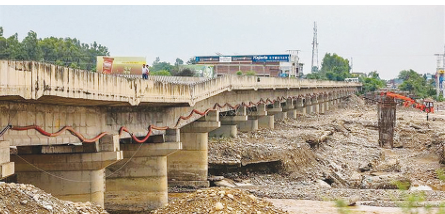
Recently in Parliament, Minister Gadkari has reaffirmed that all five J&K packages are underway, with three to finish by September 2025 and the rest by March 2026. He also clarified that there is no plan for differential tolls or EV exemptions on the expressway.
On the administrative side, J&K’s Chief Secretary had recently called for accelerated execution and instructed NHAI to reduce public inconvenience. But beyond such statements, no concrete traffic relief has been provided to residents.
Where the Gaps Lie :
Here’s a breakdown of the key failures hampering the project:
1. Disjointed Construction: Contractors working in isolation due to incomplete land possession.
2. Poor Diversions: Roads torn up without parallel functional diversions in place.
3. Lack of Safety: No night lighting, signages, or safety marshals at dangerous junctions.
4. Compensation Disparities: Arbitrary calculations lead to resentment and legal delays.
5. Weak Communication: No real-time progress updates, helplines, or grievance redress systems.
6. Disaster Vulnerability: Designs inadequate to handle monsoon, erosion, or landslides.
Strategic and Economic Stakes:
The Kathua–Jammu corridor isn’t just a local concern. Its impact is far-reaching:
· Pilgrimage: Delays affect access to Shri Mata Vaishno Devi Shrine, crucial for religious tourism.
· Defence Mobility: The expressway lies close to border zones; delays risk national preparedness.
· Trade & Industry: Freight delays impact J&K’s industries, especially in Kathua and Samba.
· Public Trust: Eroding faith in governance and institutions is perhaps the most critical loss.
What the Public Demands
Citizens, civil society groups, and local businesses are calling for:
· Safe, functional diversionsbefore existing roads are disrupted.
· Weekly visual progress reportsvia geotagged updates.
· Fair compensationwith uniform criteria and quick redress of disputes.
· Dedicated traffic teamsto manage choke points during peak hours.
· Ambulance/emergency lanesin ongoing construction areas.
· Independent auditsand third-party oversight of project timelines and safety.
· Local consultation forumsto build transparency and accountability.
The Delhi–Amritsar–Katra Expressway could have been amodel for connectivity, faith tourism, and regional inclusion. Instead, it currently functions as acase study in how lack of planning, poor communication, and administrative delay can derail public trust. Yet, it’s not too late.
With focused intervention, especially on land issues, safety protocols, and citizen communication, this project can still reclaim its promise. But for that to happen, decision-makers must walk the route they plan to build, see what commuters face, and respond not with press releases, but with urgency and empathy.
Until then, the people of Kathua, Samba and Jammu continue to pay the cost, not in money alone, but in time, frustration, lost opportunity, and rising risk.
Meanwhile, when contacted NHAI they were not available for the comments.
A Crumbling Economic Artery
The economic impact is no less severe. Kathua Industrial Estate, home to dozens of small and mid-sized units, has seen a 40–50% increase in transportation costs over the past year. Suppliers from Punjab now refuse to dispatch goods via this route unless paid extra.
In Samba, raw material delays have caused contract penalties and cancelled orders. Tour operators ferrying pilgrims to Mata Vaishno Devi report avoiding the Kathua entry point altogether, opting instead for longer but more reliable routes via Pathankot or Punjab’s internal highways.
“This is not just inconvenience. This is economic strangulation,” says a local transporter Ravi Manhas. “If they can’t finish the highway, at least fix the existing one.”
BOX:
Voices from people:
“A college student, Suhani, expressed the challenges of leaving early to ensure timely arrival at the institution, highlighting the risk of missing classes due to prolonged traffic delays.”
Mahi, a regular commuter between Jammu and Kathua, lamented: what should have been a 1‑hour 45‑minute journey now takes three hours due to expressway works at Chadwal, Dyala Chak, and Rajbagh areas. Our lungs are affected now due to dust and frequent traffic congestion.
“Emergency vehicles can’t pass. It’s a risk to life every day.” — Local Resident, Ghagwal
Traders and manufacturers in Kathua and Samba report rising costs and broken supply chains. Transporters say they can no longer make two round trips a day; many now attempt just one. Vehicles face higher maintenance costs because of constant rough diversions. For perishable goods, delays destroy value before delivery.
Major Bottlenecks on the Route
These locations are reported to have the worst traffic gridlocks and diversion issues:
Dayalachak – Cratered diversions, overloaded truck jams
Ghagwal – Incomplete bridge, both lanes dug up
Hiranagar – Single-lane diversions with no lighting
Samba – Open pits and flyover delays causing detours
Chadwal – Site of public protest in September 2025
(Author is Editor, The Chancellor)
