
Share This Article
DR. MAHESH KAUL
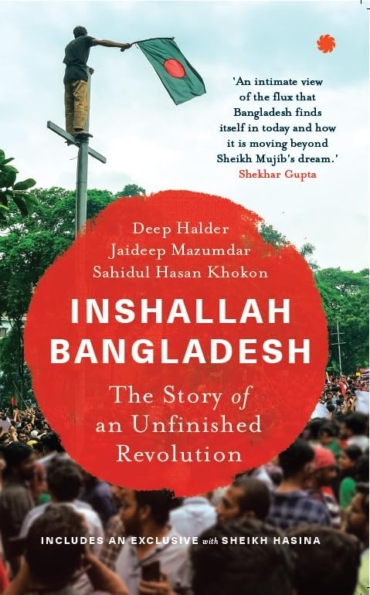
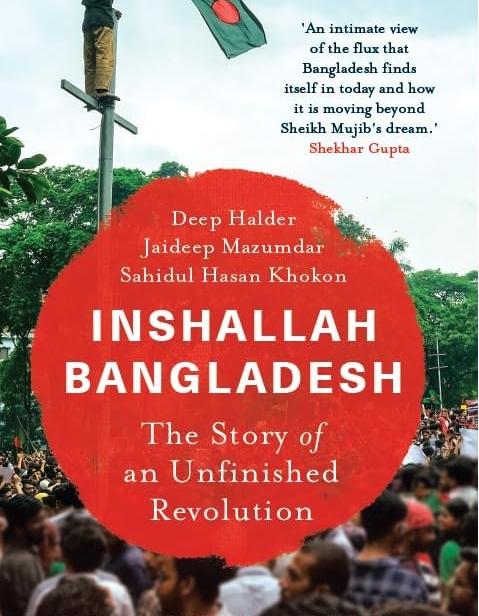
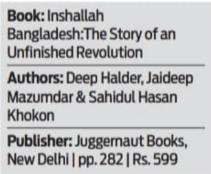
When a country rewrites its own birth certificate — burning the photographs of its liberation heroes, erasing their faces from currency notes, and saluting the flag of the nation that once tried to destroy it — something more than a political transition has taken place. Inshallah Bangladesh: The Story of an Unfinished Revolution is the urgent, deeply reported, and often disturbing account of precisely such a moment. Published by Juggernaut Books in 2025, this 282-page work by three veteran journalists — Deep Halder and Jaideep Mazumdar from India, and Sahidul Hasan Khokon, a Bangladeshi journalist who fled Dhaka for Kolkata in fear of his life — is simultaneously a political thriller, a work of investigative reportage, and a national security warning issued in the form of a book.
The book documents how student protests over job reservation quotas in 2024 spiralled into a nationwide uprising that toppled Prime Minister Sheikh Hasina’s fifteen-year government, forced her to flee to India by helicopter, and handed power to an interim administration headed by Nobel laureate Mohammad Yunus. But Halder, Mazumdar, and Khokon argue, with compelling evidence, that what followed was not a democratic spring. It was, they contend, the systematic dismantling of Bangladesh’s secular, pluralist, and India-friendly identity — and its replacement with a state increasingly aligned with Islamist forces, Pakistan, and Turkey, and openly hostile to its Hindu minority and to India.
The book opens with Sahidul Hasan Khokon’s own harrowing preface: a flight from Dhaka with a fake press card and 25,000 taka stuffed in a rucksack, passing ambulances stacked with the bodies of police officers hacked to death, and receiving a phone call from a military intelligence officer whose advice was stark: “Run before it is too late. There is no law left.” It is a beginning of cinematic urgency, and the three authors do not let that tension dissipate across the entire book.
Section I
The first section of Inshallah Bangladesh is an excavation of Bangladeshi society’s deepest fault lines: religious identity, minority persecution, the roots of anti-India sentiment, and the long shadow of Islamism over a nation born from a secular, language-based nationalism. The authors approach this section not as commentators but as reporters who have spent decades in the field, and the texture of their evidence — eyewitness testimonies, court documents, viral videos, statistical data, interviews with minority leaders, clerics, academics, and street protesters — gives it a weight that polemic could never achieve.
The Persecution of Hindus and Religious Minorities
The book’s treatment of the Hindu minority’s plight is among its most devastating and carefully documented passages. Hindus, who constituted approximately 28% of East Pakistan’s population at independence in 1947, fell to around 15% after the 1971 liberation war and now represent barely 8% of Bangladesh’s population. This demographic collapse is not, the authors argue, the result of mere emigration. It is the cumulative product of cyclical violence, land appropriation, forced religious conversion, and sustained institutional discrimination — a slow-motion ethnic cleansing that rarely makes international headlines.
The numbers the book cites are chilling. Bangladeshi newspaper Prothom Alo documented 2,500 attacks on Hindus and their properties in just 330 days under the Hasina government’s final period. But after Hasina’s fall on August 5, 2024, the authors record 2,010 additional attacks on Hindu communities in just 17 days. Temples were desecrated and demolished. Hindu women were abducted and subjected to forced conversion. Hindu-owned land was seized under mob pressure. Blasphemy charges were weaponised against community members who dared to protest.
The book draws a chilling parallel between two BBC reports separated by 24 years. In 2001, BBC documented rumours of emergency camps being set up along the border for Hindus displaced from Bangladesh — a kind of informal refuge from communal violence. In 2025, a rape video from Cumilla went viral, weaponised on social media by Islamist groups as propaganda against both Hindus and India. The structural pattern is consistent: each political transition in Bangladesh that empowers Islamist forces produces a fresh wave of anti-Hindu violence, and the Yunus transition of 2024 is no exception.
The authors document specific incidents with granular precision: the arrest and public beating of ISKCON activist Chinmoy Krishna Das in Satkhira; the desecration of the Dhakeshwari National Temple, one of the most sacred Hindu sites in the country; the burning of Hindu neighbourhoods in Comilla district. Minority leaders quoted in the book speak with a mixture of rage and resignation. Sumon Kumar Roy of the barely-legal Bangladesh Sanatan Party asks a question the book does not attempt to answer:
Patience for what? We have been patient for 53 years. Each time there is a change of government, we pay the price with our blood and our land.
The book also records the persecution of Sufi Muslims — followers of the Lalan Fakir tradition, one of Bangladesh’s most ancient and syncretic spiritual movements. Islamist groups have attacked Baul musicians, destroyed Sufi shrines, and issued fatwas against the followers of Lalan’s devotional practices. The war on minority religious expression is not directed only at non-Muslims; it is directed at any Islam that does not conform to the Wahhabi-influenced rigidity promoted by the Jamaat-e-Islami and Hefazat-e-Islam.
Former Bangladeshi Ambassador Mohammad Harun Al Rashid, writing from exile in Canada, is quoted in the book with a sombre verdict: “Secularism is a crime now. The media is traumatised, self-censoring under Yunus’s jihadists.” It is a sentence that encapsulates the section’s central finding: Bangladeshi society has undergone a value inversion, where the founding principles of the 1971 liberation — secularism, Bengali nationalism, pluralism — are now treated as suspect, even treasonous.
The Roots of Anti-India Sentiment
One of the book’s most analytically rigorous chapters examines the origins and growth of anti-India sentiment among Bangladeshi youth. The authors resist the easy explanation that this hostility is purely manufactured by Islamists, though Islamist manipulation is certainly documented. Instead, they trace a multi-layered web of grievances.
Indian support for the Hasina government — perceived by many Bangladeshis as unconditional backing for a regime that was corrupt, authoritarian, and capable of mass electoral fraud — became the primary grievance. India, in the eyes of younger Bangladeshis who had known only the Hasina era, was not the liberator of 1971 but the enabler of their oppression. The book records that border killings by India’s Border Security Force (BSF) — a significant and documented pattern of fatal shootings of Bangladeshi nationals along the border — fuelled deep resentment that cut across religious lines.
But the Islamist narrative layer sits beneath these legitimate grievances. The book documents how Islamist organisations have systematically promoted the idea that India is a Hindu state pursuing a civilisational agenda against Muslim Bangladesh, and that Indian influence inside Bangladesh — through intelligence penetration, media ownership, and cultural projection — amounts to a new form of colonialism. This narrative, the authors show, has been swallowed wholesale by a generation of Bangladeshis who have grown up on a diet of social media content produced by Pakistan-funded Islamist digital networks.
A disturbing scene at Dhaka University captures the cultural moment: students are recorded reciting rhymes about Bangladesh absorbing India’s northeastern states. A female research scholar recites a limerick about Bangladeshis visiting Arunachal Pradesh and Nagaland — territories she describes as areas that will “soon become part of our country.” The book treats this not as fringe extremism but as a mainstream symptom of the ideological transformation that Section I maps with methodical care.
Section II
If Section I is a sociological autopsy, Section II is a political thriller told in real time. It reconstructs the events of July and August 2024 with granular detail: the student protests, the government’s brutal crackdown, the army’s calculated withdrawal of support from Hasina, and her final hours at Gonobhaban — the official prime ministerial residence — before boarding a helicopter to India.
The Fall of Sheikh Hasina
The authors’ account of Hasina’s last days in power is both riveting and historically significant. On August 4, student leaders advanced their Long March to Dhaka from August 6 to August 5. Hasina ordered security agencies to prevent the march. Army generals present at the security meeting told her that deploying lethal force against the march risked triggering civil war. They urged her to negotiate. Hasina, whose political instinct had always been to hold ground, vacillated. Her family, haunted by the memory of August 15, 1975, when her father Sheikh Mujibur Rahman and most of her family were massacred in a military coup, ultimately convinced her to flee.
The book presents a devastating portrait of institutional collapse: the police force abandoned its posts, the Rapid Action Battalion commanders defected, the army generals who had been Hasina’s ultimate guarantors of power chose to let her fall. The authors report whispered accounts from unnamed military officers of a deliberate plan, coordinated well before August 5, to remove Hasina while presenting her departure as a response to popular pressure. Whether this amounts to a CIA conspiracy — as Hasina has claimed — or a domestic military-political recalibration, the book leaves as an open question, wisely declining to endorse any single explanatory framework.
The book records the authors’ thirteen-minute telephone conversation with Hasina from her exile in India — a conversation she uses entirely as a political monologue, promising to return
Inshallah, I shall return. I will deliver justice to my people and bring to book these people who have betrayed my nation.
The chapter examining Hasina is titled “Good Hasina, Bad Hasina,” and the authors show both dimensions with admirable even-handedness: the prime minister who presided over remarkable economic growth, the garment industry’s expansion, and genuine improvements in women’s health and literacy; and the autocrat who stuffed ballot boxes, disappeared political opponents, gave the RAB carte blanche to commit extrajudicial killings, and allowed the state apparatus to be penetrated by her party loyalists.
Mohammad Yunus: The Nobel Laureate as Radical Enabler
The book’s most explosive and politically consequential section is its detailed, documented indictment of Mohammad Yunus. The authors frame this with care: they do not dismiss Yunus’s international reputation or deny his genuine contributions to microfinance and women’s economic empowerment through Grameen Bank. But they argue, with substantial evidence, that as head of the interim government Yunus has systematically dismantled the institutions that protected Bangladesh’s secular identity, empowered Islamist organisations with violent track records, and oriented Bangladesh’s foreign policy away from India and toward a Pakistan-Turkey-China axis that poses a direct threat to regional stability.
The most alarming of Yunus’s early decisions, as documented by the authors, was the release of Jashimuddin Rahmani, the chief of the Islamist terror outfit Ansarullah Bangla Team (ABT). The ABT openly calls for the extermination of Hindus and advocates Ghazwa-e-Hind — the Islamic conquest of India and its transformation into an Islamic republic. Rahmani’s release was not an oversight; it was a signal. The Yunus dispensation subsequently gave him effective freedom to expand the ABT network across Bangladesh.
Alongside Rahmani, the book documents the release of BNP leader Abdus Salam Pintu, who had been sentenced to death in connection with a 2004 grenade attack and was known to have aided the Pakistan-based terror group Harkat-ul-Jihad-al-Islami in weapons procurement and training at camps in Pakistan-occupied Kashmir. Also freed was Lutfozzaman Babar, the former Minister of State for Home who had been the key figure behind the foiled 2004 attempt to supply arms to the separatist United Liberation Front of Asom (ULFA) in India. The systematic release of convicted terrorists and Islamist radicals by the Yunus administration amounts, the book argues, to a deliberate recalibration of the Bangladeshi state’s relationship with political violence.
Yunus’s manipulation of the judiciary is documented in equal detail. Following the August 2024 demonstrations, the interim regime compelled Chief Justice of the Supreme Court Obaidul Hassan and five other senior justices to resign under mob pressure — an act that constituted a direct assault on judicial independence. Their replacements, the book reports, have strong Islamist leanings. The Yunus administration has effectively captured Bangladesh’s highest court and reshaped it as an instrument of the new Islamist order.
The book records Yunus’s foreign policy as an extension of this ideological project. He met Pakistani Prime Minister Shehbaz Sharif twice — on the sidelines of the UN General Assembly in September 2024 and at the D-8 Summit in Cairo in December 2024 — and reportedly requested that Pakistan settle outstanding issues from the 1971 war. In practical terms, this meant seeking to rehabilitate the legacy of 1971 war criminals and whitewash the Pakistani military’s genocide of Bengalis. During his March 2025 visit to China, Yunus made the extraordinary statement that Bangladesh could serve as China’s gateway to Northeast India — a claim that, the book argues, is a direct invitation for Chinese strategic encroachment into India’s most sensitive and insurgency-affected region.
Pakistan’s ISI, the book reveals, has been extraordinarily active in post-Hasina Bangladesh. Senior ISI officials made multiple trips to Dhaka in January 2025, including visits to areas near the Indian border in Rangpur and the Chittagong Hill Tracts. Turkish intelligence agency MIT has established close ties with Jamaat-e-Islami and is financing anti-India Islamist networks. The book’s argument — that Bangladesh under Yunus has been deliberately repositioned as a frontline state in a Turkey-Pakistan-China axis against India — is supported by a body of evidence that Indian policymakers cannot afford to dismiss.
The ‘Greater Bangladesh’ Fantasy
Section II also documents perhaps the most alarming ideological development in post-Hasina Bangladesh: the mainstreaming of the fantasy of a ‘Greater Bangladesh’ that would absorb India’s northeastern states. The book records retired Major General ALM Fazlur Rahman, former Director General of the Bangladesh Rifles, posting on Facebook that if India attacks Pakistan, Bangladesh should occupy the seven states of Northeast India. His platform, Nirdolio Jano Andolan, openly advocates raising a national army to invade India, liberate Northeast India and Sikkim, and annex Assam, West Bengal, Bihar, and Odisha into Bangladesh.
Students at Dhaka University recite nationalist rhymes claiming Bangladeshi sovereignty over Indian territories. Teachers at Bangladeshi universities lead rallies demanding the deployment of the Bangladesh armed forces to occupy Northeast India. The book makes clear that this is not fringe radicalism. It is a growing mainstream fantasy, nurtured by Islamist ideology, anti-India propaganda, and the institutional impunity that the Yunus administration has extended to those who advocate it.
At the Jinnah commemoration held at Dhaka’s National Press Club on September 11, 2024 — an event that would have been utterly unthinkable before August 5 — Urdu songs praising Pakistan’s founder were sung and speakers argued that without Jinnah, Bangladesh would not have existed. The Pakistani Deputy High Commissioner attended. The 1971 genocide had been ideologically rehabilitated in just six weeks.
Section III
The book’s third section is its most human. Returning to the testimonial mode that gives the entire work its moral weight, the authors gather the voices of those whom the political and sociological analysis of the first two sections could easily reduce to statistics: Hindu families who have lost everything; secular Bangladeshi intellectuals living in fear of mob violence; Awami League politicians in hiding; army officers wrestling with their own role in the transition; young Bangladeshis who were genuinely frustrated by Hasina’s authoritarianism and yet horrified by what replaced it.
The Human Cost of Majoritarian Violence
The personal accounts of Hindu and Buddhist minority communities in this section carry a devastating specificity that statistics cannot. The book records families whose ancestral homes were torched by mobs within hours of Hasina’s departure. A Hindu schoolteacher in Jessore describes watching a crowd pull the statue of Saraswati from her school’s courtyard and shatter it. A Buddhist family from the Chittagong Hill Tracts describes the arrival of plainclothes men — linked, they believe, to Jamaat — who informed them their land had been ‘transferred’ to a local party official and they had 48 hours to leave.
The authors record a particularly haunting exchange with a Hindu leader who asks them: when Yunus publicly buries the secular promise of 1971, does the idea of a Hindu homeland within Bangladesh — the old fantasy of Bangabhumi, a refuge for Hindus in the southwestern districts from Jessore to Patuakhali — become not a fringe aspiration but a matter of survival? The book does not endorse this idea, but it takes seriously what it reveals: that Bangladesh’s Hindu community, reduced to under 8% of the population, is approaching a threshold of existential despair.
Some of the book’s most poignant passages record the testimony of secular, progressive Bangladeshis — academics, journalists, lawyers, artists — who supported the uprising against Hasina but now feel trapped by its consequences. A senior Dhaka University professor, unnamed for his protection, tells the authors: the students wanted freedom. What they got was a new cage, built by Jamaat instead of the Awami League.
The book captures the particular anguish of those who had celebrated August 5 as a liberation, only to watch Islamist mobs systematically erase the cultural markers of Bangladesh’s secular identity: the murals of Sheikh Mujibur Rahman scrubbed from public walls, the 1971 liberation monuments defaced, the banknotes depicting the country’s founders withdrawn from circulation. The revolution that overthrew Hasina’s authoritarianism has produced, the book argues, not freedom but a new authoritarianism — one rooted in religious majoritarianism rather than dynastic politics, and therefore far harder to oppose.
Among the most compelling individual portraits in Section III is that of Naquib Azad, the student protest leader who became a brief national hero before his own movement marginalised him. The authors trace his arc with considerable sympathy: a young man who genuinely believed he was leading a democratic uprising and who found himself, almost without understanding how, providing the popular legitimacy for a transition that served interests very different from his own. His subsequent disillusionment and fear — he is among those who no longer feels safe in the Bangladesh he helped transform — stands as the section’s emblematic personal story.
Critical Assessment
Inshallah Bangladesh is, at its best, indispensable journalism. The authors’ combination of on-the-ground reporting, first-person testimony, and political analysis gives the book a density of evidence that makes its central arguments difficult to dismiss. The documentation of minority persecution, the evidence of Yunus’s Islamist enablement, the charting of Bangladesh’s geopolitical realignment toward Pakistan, Turkey, and China — these are not matters of interpretation but of documented fact, cross-referenced and sourced.
The book does have limitations that more critical readers will note. Its treatment of Hasina tends toward sympathy that occasionally obscures the systemic abuses of her government: the enforced disappearances, the extrajudicial killings by the RAB, the rigged elections of 2014 and 2018. The authors make a reasonable defence that their focus is on the post-August 2024 period, but a fuller accounting of why so many Bangladeshis — including secular ones — wanted Hasina gone would have strengthened the book’s analytical credibility.
The book’s Indian perspective is both its strength and its acknowledged limitation. Halder, Mazumdar, and Khokon write with a clarity about India’s strategic interests that is rare in Indian journalism. But readers should be aware that their frame is, essentially, New Delhi’s frame: Bangladesh’s trajectory matters because it threatens India. The lived experience of Bangladeshis who have legitimate grievances against Indian border policy, Indian intelligence interference, and Indian political pressure is engaged with, but not always as deeply as it deserves.
These are qualifications, not disqualifications. Inshallah Bangladesh remains the most comprehensive, the most urgent, and the most important book written about Bangladesh’s 2024 revolution and its aftermath. For Indian policymakers, strategic thinkers, and engaged citizens, it functions — as one reviewer accurately described it — as a national security document disguised as reportage.
Conclusion
The book’s title carries its ambiguity deliberately. Inshallah — Arabic for ‘if God wills it’ — is the word Sheikh Hasina uses when the authors ask whether she will return to Bangladesh. It is also the word the country’s Islamists use when they speak of Bangladesh’s transformation into a fully Islamic state. It is, the authors seem to suggest, the word Bangladesh itself is living by: a country whose future is suspended between hope and catastrophe, between the secular promise of 1971 and the Islamist vision of 2024.
The Hindu community of Bangladesh, now under 8% and shrinking, cannot afford to wait for God’s will. The secular intellectuals and journalists being driven into exile cannot wait. India, with 4,156 kilometres of shared border, a Bengal-speaking Hindu minority in West Bengal directly affected by events across that border, and strategic interests threatened by the Bangladesh-Pakistan-Turkey-China axis now taking shape, cannot wait.
Inshallah Bangladesh is a book that demands urgency — of Bangladesh’s leaders, of India’s policymakers, and of the international community that has been content to see Mohammad Yunus’s Nobel Prize halo as a substitute for scrutiny of his administration’s record. The turbulence of 2024 may be unfinished. The crisis it has unleashed is very much present.
(Author is Editorial Director, The Chancellor)